
 Wound Care

If you or a parent has a wound that is slow to heal, you may be weighing two options that sound like they do the same job. This guide compares home health wound care vs wound clinic care in plain terms: what each one does, who each one is designed for, how they are ordered, and how the two often work together instead of competing with each other.
The short answer is that a wound clinic and a home health agency play different roles. A wound clinic is an outpatient specialty setting that you travel to. Home health is skilled care that comes to you, but only if you are homebound and a physician or other allowed provider orders it under a home health plan of care. Many patients in Los Angeles County end up using both at the same time. This article explains how to think through the choice and what questions to ask.
Home health wound care vs wound clinic: the basic difference
A wound clinic, sometimes called a wound center, is an outpatient practice that focuses on wounds that are complex, chronic, or not healing as expected. It is usually staffed by physicians, podiatrists, nurse practitioners, and wound-certified nurses. You go to the clinic for an appointment, the team evaluates the wound, may perform procedures, and then sends you home with instructions until the next visit.
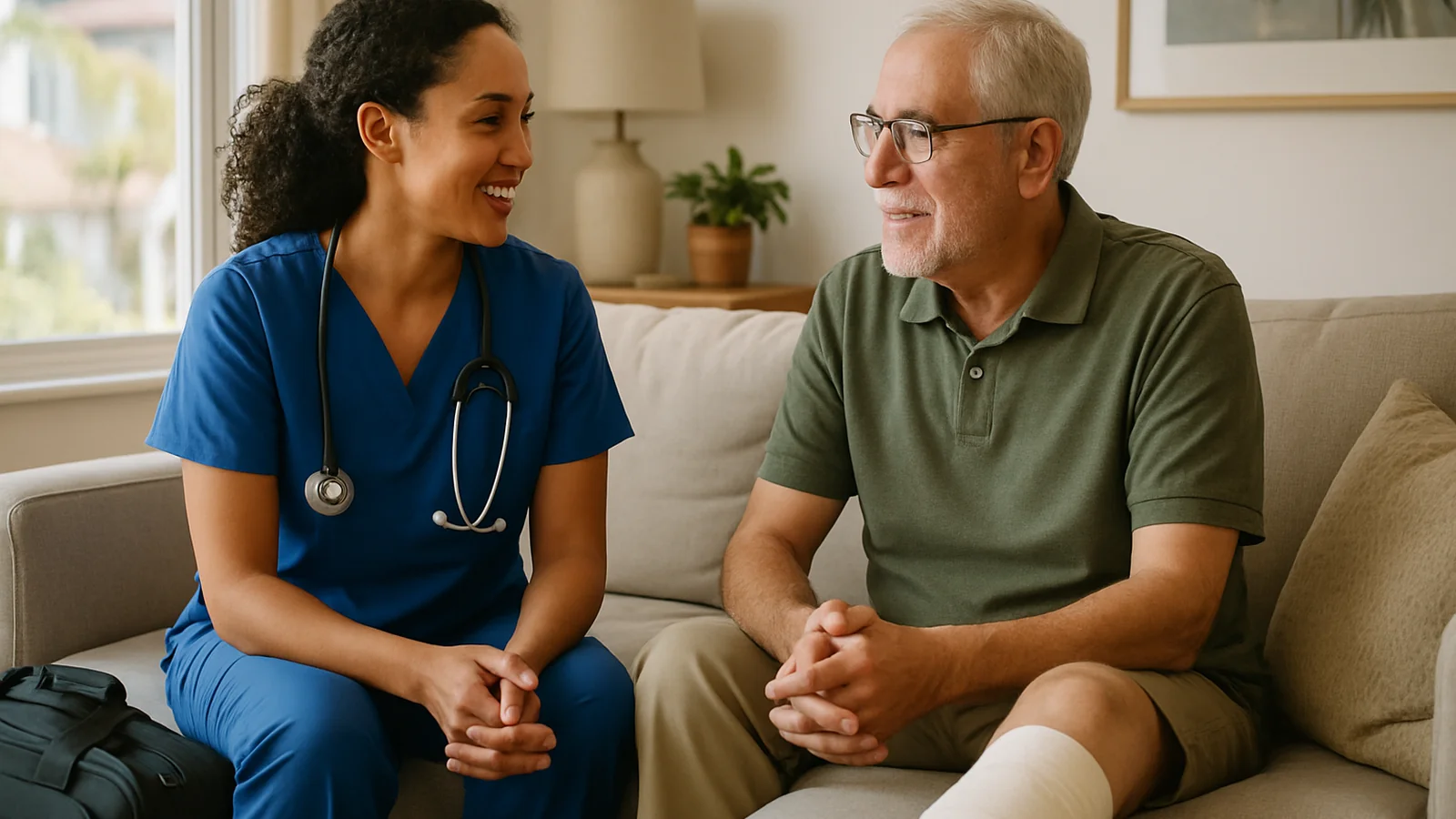
Home health is a different kind of service. A Medicare-certified home health agency such as HarvardCare Home Health sends licensed nurses and therapists to the patient’s home on a schedule set by the physician-ordered plan of care. For wounds, that usually means skilled nursing visits for in-home wound care services: assessing the wound, carrying out the ordered treatment, teaching the patient and family, and reporting changes to the provider.
The two settings answer different questions. A wound clinic answers, what does this wound need from a specialist? Home health answers, how does the ordered care get done safely at home between appointments for someone who cannot easily leave the house?
What a wound clinic usually offers
Every clinic is different, and services vary by location and by the physicians who practice there. In general, a wound clinic may offer some or all of the following:
- Specialist evaluation. A physician or advanced practice provider who focuses on wounds looks at the cause, not just the wound itself, and decides on a treatment plan.
- Procedures. Many clinics perform sharp or surgical debridement, which removes dead or damaged tissue so a wound can move toward healing. You can read more in our article on what wound debridement is and why it helps.
- Testing and imaging. Clinics may order or perform tests such as circulation checks, cultures, biopsies, or imaging to look for infection in deeper tissue or problems with blood flow.
- Advanced therapies. Some clinics offer hyperbaric oxygen therapy, skin substitutes, or specialized products that require a provider to apply them in the office.
- Referrals to other specialists. A clinic may connect you with vascular surgery, infectious disease, podiatry, or endocrinology when the wound points to a larger problem.
The trade-off is travel. A wound clinic visit means getting dressed, getting to the car or a ride, sitting in traffic, finding parking, waiting, and making the return trip. For a person who is strong enough to do that, it is a reasonable part of the week. For a person who is frail, in pain, or recovering from a hospital stay, it can be exhausting.
What home health wound care usually offers
Home health wound care is skilled nursing delivered where the patient lives. When it is ordered and medically necessary, a home health nurse may:
- Assess the wound at each visit, including size, drainage, the skin around the wound, and signs of infection.
- Carry out the ordered treatment, such as cleansing the wound and applying the specific dressings the provider prescribed. Our page on wound dressing changes at home explains this part of the service.
- Teach the patient and family how to care for the wound between visits, what supplies to use, and when to call.
- Check vital signs, pain, nutrition, blood sugar habits for people with diabetes, and medications that may affect healing.
- Look at the home setup, such as the bed, cushions, and how the patient moves, when pressure is part of the problem.
- Report changes to the ordering provider and, when one is involved, to the wound clinic.
Home health nurses do not perform surgical debridement in the home, do not run imaging, and do not provide hyperbaric oxygen. Their role is to carry out the plan the provider writes, watch closely for changes, and keep the care team informed. Physical or occupational therapy may also be part of the plan when mobility, transfers, or positioning affect the wound.
To see what this looks like in practice, read what happens at a home health wound care visit, step by step.
Who home health wound care is for
This is the most important part of the comparison. Home health is not simply a convenience option for anyone who would rather not drive to a clinic. Under Medicare rules, a patient generally must meet several conditions before the home health benefit may apply:
- Homebound status. Under CMS criteria, the patient needs a device such as a walker or wheelchair, special transportation, or another person’s help to leave home because of illness or injury, or leaving home is medically not advised. In addition, the patient is normally unable to leave home, and leaving requires a considerable and taxing effort.
- A provider’s order and plan of care. A physician or other allowed provider must order home health and sign off on a plan of care.
- A face-to-face encounter. The patient needs a visit with a provider related to the main reason for home health, within 90 days before or 30 days after the start of care.
- A skilled need. The patient needs intermittent skilled nursing, physical therapy, speech therapy, or continuing occupational therapy. Wound care that requires a nurse’s skill often meets this part.
Homebound does not mean a person can never leave the house. Trips for medical care, including wound clinic appointments, do not by themselves disqualify someone. Neither do adult day care, religious services, or infrequent short outings such as a haircut or a family event. Our article on what qualifies as homebound for Medicare walks through the criteria in more detail.
If you drive yourself, run errands, and go out regularly without much strain, home health is usually not the right fit. In that case, a wound clinic or your regular provider’s office is generally the better route, and that is a perfectly good path to healing.
Who a wound clinic is for
A wound clinic is a good fit for almost anyone whose wound needs specialist attention, as long as they can get there. It may be especially helpful when:
- A wound has not improved over several weeks despite regular care.
- The provider suspects poor circulation, a deep infection, or another underlying problem that needs testing.
- The wound needs debridement or another procedure.
- The patient may be a candidate for advanced therapies that are only offered in a clinic.
- The patient is mobile enough to travel and prefers to manage dressing changes on their own or with family help between visits.
A wound clinic does not require a patient to be homebound. That is one of the clearest differences. Many active adults with diabetic foot wounds, leg ulcers, or slow surgical wounds go to a clinic weekly and handle daily dressing changes at home.
How the two can work together
The choice between a wound clinic and home health does not have to be either-or. For many homebound patients, the most practical setup is a combination:
- The wound clinic evaluates the wound, performs any procedures, and writes or updates the treatment orders.
- The home health nurse visits between clinic appointments to carry out those orders, change dressings as prescribed, and watch for problems.
- The nurse reports what they see back to the provider who signs the plan of care, and to the clinic when that is part of the plan.
- At the next clinic appointment, the specialist sees the wound with the benefit of the nurse’s notes and adjusts the plan if needed.
In this setup, the clinic directs the wound treatment and home health carries it out in the home. The patient may only need to make the trip to the clinic when the specialist needs to see the wound in person, rather than for every dressing change. For more on how this communication works, see our article on how home health nurses coordinate with your doctor and specialists.
Going to wound clinic appointments does not by itself mean a patient is no longer homebound. Absences for medical care are expected. What matters is whether leaving home in general takes a considerable and taxing effort because of the patient’s condition.
A side-by-side comparison
Here is a simple way to compare the two settings on the points families ask about most.
Where care happens
A wound clinic is an outpatient office or hospital-based department. Home health wound care happens in the patient’s home, which may be a house, an apartment, or a family member’s home where the patient is staying.
Who can use it
A wound clinic is generally open to patients who can travel and have a referral if the clinic or plan requires one. Home health is for patients who meet homebound criteria and have a qualifying skilled need, with a provider order and face-to-face encounter.
What is done
A wound clinic may provide specialist evaluation, debridement, testing, and advanced therapies. Home health provides skilled nursing assessment, ordered dressing changes and treatments, teaching, monitoring, and coordination.
How often
Clinic visits are scheduled by the clinic, often weekly or every few weeks, depending on the wound. Home health visit frequency is set by the physician-ordered plan of care and may change as the wound changes. No agency can promise a fixed number of visits.
Coverage
Medicare may cover medically necessary wound clinic services under Part B, subject to the usual cost-sharing. Medicare may cover home health services for eligible homebound patients when they are medically necessary and ordered. Medicare Advantage and other plans have their own rules, networks, and authorization steps. Medicare’s own page on home health services coverage describes the basic requirements. To ask about your plan with HarvardCare Home Health, visit our insurance page.
Questions to help you decide
If you are not sure which setting fits, these questions can help you talk it through with the treating provider:
- Can the patient leave home without major strain? If the answer is yes, a wound clinic or provider’s office is usually the main path. If the answer is no, home health may be worth discussing.
- Does the wound need a procedure or test? If so, a clinic or provider office will likely be involved, even if home health also visits.
- Who is doing dressing changes today? If a family member is unsure, overwhelmed, or unable to do them correctly, a skilled nurse’s teaching and visits may help.
- Is the wound getting worse between appointments? More frequent skilled observation between clinic visits may help the provider catch changes sooner.
- Are there other health problems in the picture? Diabetes, heart failure, poor nutrition, limited mobility, or many medications can all affect healing. Home health nurses look at the whole picture during their visits.
If you are looking into in-home providers that are not home health agencies, our separate guide on mobile wound care vs Medicare home health in Los Angeles explains how those services differ. This article focuses on the clinic option instead.
The Los Angeles County angle
The distance between a patient and a wound clinic is not just measured in miles in Los Angeles County. A clinic that is ten miles away on a map can be a long drive across town at the wrong time of day. For a patient with an open foot wound or a painful pressure injury, sitting in a car for an hour each way can be hard on the body and on the wound.
The home itself matters too. Many patients live in older apartment buildings without elevators, in multi-story homes, or on hillside streets where getting from the front door to a car takes real effort. A walker on steep steps or a wheelchair on a narrow walkway can turn a short outing into a major event. These details are part of what a provider considers when deciding whether a patient is homebound.
Family schedules also play a role. Many caregivers work full time and cannot take a weekday morning off for every appointment. Some families speak more than one language at home, and the person who translates during visits may not be available every week. Home health visits happen at home, which can make it easier for the caregiver who handles the dressings to be present for teaching.
HarvardCare Home Health serves homebound patients across the county, including neighborhoods in Pasadena, Glendale, and Long Beach. Whether a specific address is in our service area is confirmed during intake.
When a wound is not healing as expected
A wound that stalls, gets bigger, or develops new symptoms deserves prompt attention, no matter which setting you use. Signs to report to the treating provider include increasing redness or warmth, new or worsening drainage or odor, more pain, a wound that opens wider, or a fever. A slow wound is often the reason patients are referred to a wound clinic in the first place, and it is also a common reason home health nursing is ordered.
For homebound patients, the two settings can share the work. The clinic looks for the reason the wound is stuck and adjusts the treatment. The home health nurse carries out that treatment, watches how the wound responds, and teaches the family. Our page on non-healing wound care at home describes how this works for chronic wounds.
Home health is not an emergency service. If someone has signs of a serious infection with confusion, trouble breathing, chest pain, or rapid worsening, call 911 or go to the nearest emergency department.
Ongoing leg swelling is one common reason a lower-leg wound heals slowly. Our article on edema wound care at home explains how swelling and weeping skin may be managed under a provider’s orders.
How to start either path
The steps are different depending on where you begin.
Starting with a wound clinic
Ask your primary care provider or surgeon whether a wound clinic referral makes sense. Some plans require a referral or prior authorization for specialty care. Bring a list of medications, any recent hospital discharge papers, and notes on how long the wound has been there and what has been tried.
Starting with home health
Talk with the treating provider about whether home health is appropriate. If the patient is homebound and has a skilled need, the provider can send an order. Families can contact a home health agency directly to ask about eligibility, and the agency can coordinate with the provider. Doctors, discharge planners, and case managers can send a referral through the agency’s referral process. Patients generally have the right to choose their home health agency.
If the patient is already seeing a wound clinic, tell the home health agency the name of the clinic and the current orders. That helps the agency coordinate with the clinic from the first visit.
This article is general education, not medical advice. Always follow the orders and guidance of the treating provider.
Frequently asked questions about home health wound care vs wound clinic care
Can I use a wound clinic and home health at the same time?
Yes, many homebound patients do. The clinic may direct the wound treatment and perform procedures, while the home health nurse carries out the orders between clinic visits and reports back. Attending medical appointments does not by itself disqualify a patient from being homebound.
Does home health replace the wound clinic?
Not usually. Home health nurses carry out the treatment the provider orders, but they do not perform surgical debridement, imaging, or hyperbaric oxygen therapy at home. If the wound needs those services, the clinic or another provider will still be involved.
Do I have to be homebound to go to a wound clinic?
No. Wound clinics are outpatient services and do not require homebound status. Home health is the option that generally requires the patient to be homebound under Medicare rules.
Will Medicare pay for both?
Medicare may cover medically necessary wound clinic services under Part B and may cover home health services for eligible homebound patients when ordered. Cost-sharing, plan rules, and authorization requirements vary, especially for Medicare Advantage plans. The agency’s intake team can review your coverage before care begins.
How often will a home health nurse come for a wound?
Visit frequency is set by the physician-ordered plan of care and depends on the wound, the dressing type, and how the wound is responding. It may change over time. No agency can promise a specific number of visits.
Who decides which wound dressings to use?
The treating provider, which may be the wound clinic physician, orders the dressings and treatment. The home health nurse follows those orders, reports how the wound is doing, and may suggest the provider review the plan if the wound changes.
What if the patient is not homebound?
If the patient can leave home regularly without considerable and taxing effort, home health is usually not the right fit, and HarvardCare Home Health would not be able to admit them under the home health benefit. A wound clinic or the provider’s office is generally the better path in that case.
Talk with HarvardCare Home Health about wound care at home
If a homebound patient in Los Angeles County needs skilled wound care between clinic visits, HarvardCare Home Health can review eligibility and coordinate with the treating provider. Call (323) 484-4440, or use our contact form if you are a patient or family member. Doctors, discharge planners, and case managers can send patient information through our referral form.
Contacting HarvardCare Home Health does not guarantee admission, coverage, visit frequency or a start date. Eligibility depends on homebound status, a provider order, a face-to-face encounter, and a skilled need under a home health plan of care.
