 HarvardCare at Home
  Wound Care
 Skilled Nursing Care
 Physical Therapy
 Occupational Therapy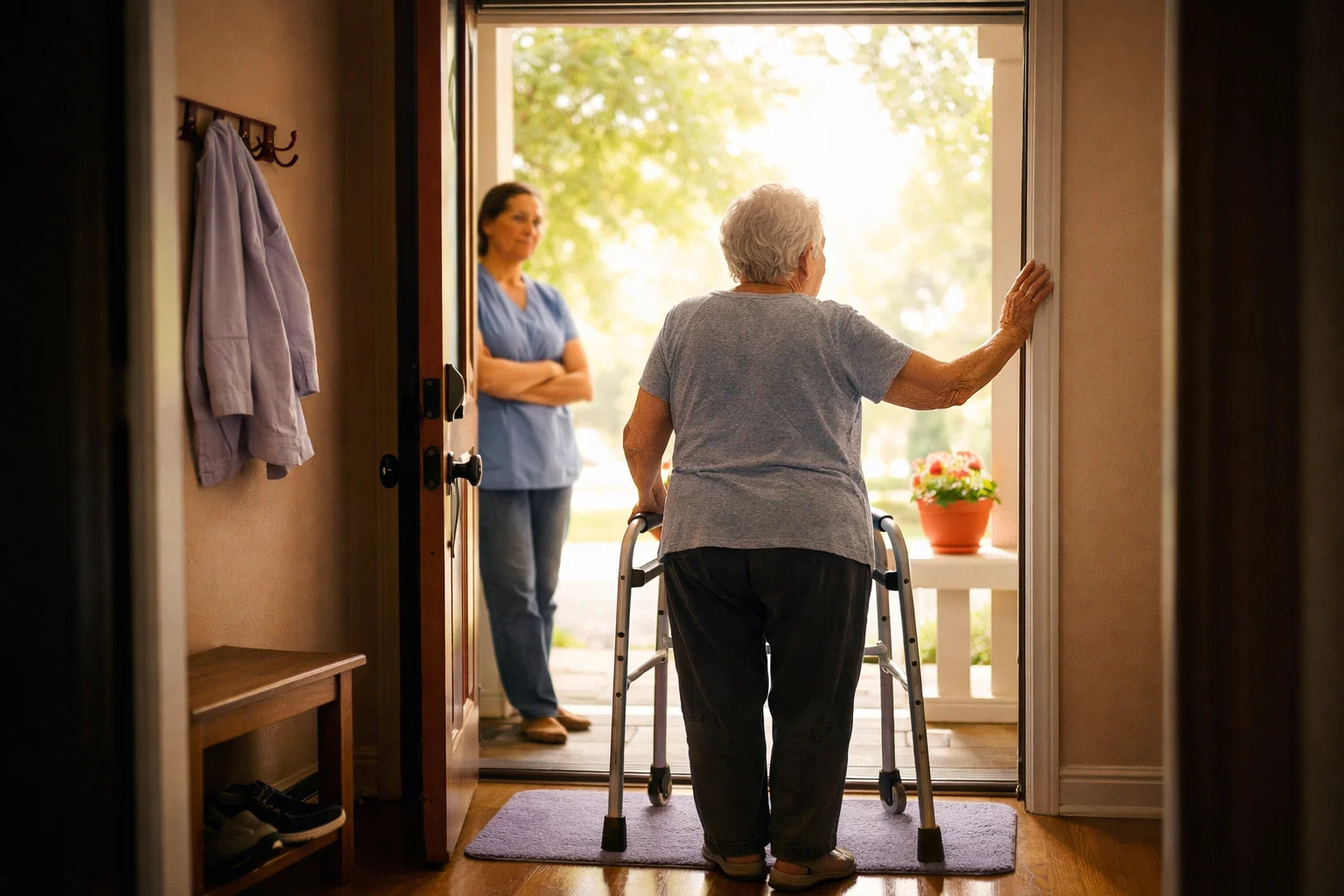

One of the most common reasons people miss out on Medicare home health benefits is a simple misunderstanding: they assume they don’t qualify because they’re not bedridden. In reality, Medicare’s definition of “homebound” is much broader than most people think — and if you or a loved one needs skilled medical care at home, there’s a good chance you meet the criteria.
This guide explains exactly what qualifies as homebound under Medicare in 2026, common examples, what doesn’t disqualify you, and how to get started with home health care through a Medicare-certified agency like HarvardCare at Home, serving all of Los Angeles County.
The Official Medicare Definition of Homebound
Medicare defines a patient as homebound when leaving home requires a considerable and taxing effort due to illness, injury, disability, or cognitive impairment. This is the legal standard used by Medicare to determine eligibility for home health benefits. It does not mean you are confined to your bed or your house 24 hours a day.
Specifically, Medicare considers you homebound if one or more of the following apply: you need the assistance of another person to leave home safely; you require a supportive device such as a walker, cane, crutches, wheelchair, or prosthesis to leave home; your doctor believes your health or condition could worsen if you leave home; or leaving home is medically contraindicated due to your condition.
CMS (Centers for Medicare and Medicaid Services) uses the phrase “normal inability to leave home” — meaning that leaving is not a normal part of daily life because of your medical situation, even if it is theoretically possible with great effort.
Common Conditions That Qualify as Homebound
A wide range of medical conditions can establish homebound status under Medicare. You do not need to have a specific diagnosis — what matters is the functional impact your condition has on your ability to leave home safely and regularly.
Mobility Limitations
Patients who have had a recent hip replacement, knee replacement, or major orthopedic surgery frequently qualify as homebound during recovery. Using a walker or wheelchair to navigate and relying on another person to get in and out of a vehicle satisfies the homebound standard. Our hip replacement rehab at home and knee replacement rehab at home teams serve many patients in exactly this situation.
Wound Care Needs
Patients with complex wounds — including diabetic foot ulcers, pressure ulcers, venous leg ulcers, post-surgical wounds, or infected wounds — often qualify as homebound because their wound makes walking painful or unsafe, or because infection risk makes unnecessary outings medically inadvisable. If you have a wound requiring skilled nursing care and leaving home is difficult or risky, you very likely qualify. Learn more at our Medicare wound care Los Angeles page or our in-home wound care services page.
Neurological Conditions
Stroke survivors who have weakness, paralysis, balance problems, or difficulty with transfers qualify as homebound during their recovery. Patients with Parkinson’s disease, multiple sclerosis, or other progressive neurological conditions often qualify on an ongoing basis when their functional status makes independent community mobility impossible or unsafe. Our stroke rehab at home team provides care throughout Los Angeles for patients in this situation.
Cardiac and Respiratory Conditions
Patients with severe heart failure, COPD, or other cardiopulmonary conditions who experience significant shortness of breath or fatigue with minimal exertion frequently qualify as homebound. If walking to a car or climbing stairs causes chest pain, severe dyspnea, or dangerously elevated heart rate, leaving home represents exactly the kind of taxing effort Medicare’s definition contemplates. Learn about managing heart failure at home and managing COPD at home with skilled nursing.
Dementia and Cognitive Impairment
Patients with moderate to severe dementia or Alzheimer’s disease qualify as homebound when leaving home safely requires constant supervision and assistance due to confusion, wandering risk, or inability to follow safety instructions. The cognitive component of homebound status is well established in Medicare policy and frequently applies to patients who are physically capable of walking but cannot safely navigate community environments independently. Read more in our guide on how occupational therapy supports dementia patients at home.
Post-Surgical Recovery
After major surgery — cardiac, abdominal, orthopedic, vascular, or oncological — patients are frequently homebound during the initial recovery period. Surgical wounds, pain with movement, activity restrictions ordered by the surgeon, and the exertion involved in travel all contribute to homebound status. Our post-hospital discharge nurse at home service specifically serves patients in this transitional period. Read more about home health after surgery week by week.
Fall Risk and Balance Disorders
Patients with a recent fall history, documented fall risk, severe balance disorders, or lower extremity weakness who require supervision or assistive devices to ambulate safely outside the home qualify as homebound. Medicare recognizes that requiring another person to accompany you to prevent falls is a form of the “considerable and taxing effort” standard. Our fall risk assessment at home and fall prevention therapy at home teams work with homebound patients throughout LA County.
What Does NOT Disqualify You as Homebound
This is where many patients — and even some healthcare providers — get confused. Being homebound does not mean you are completely unable to leave home. Medicare explicitly allows homebound patients to leave home for certain purposes without losing their homebound status.
You can still leave home for medical appointments (physician visits, lab draws, dialysis, chemotherapy, wound care clinic visits) without losing homebound status. You can attend adult day care programs or adult day health care programs and remain homebound. And You can attend religious services. You can take brief, infrequent outings for special family events such as a birthday or holiday gathering. The key is that these outings are infrequent, require considerable effort, and are not a normal, regular part of your daily routine.
Medicare’s guidance is clear: the fact that a patient occasionally leaves home does not automatically negate homebound status, as long as leaving home is not a regular occurrence and requires significant effort each time.
How Homebound Status Is Documented
Your homebound status must be documented by a physician in your plan of care and supported by clinical notes from your home health nurses and therapists. Good documentation of homebound status includes a clear description of why leaving home requires considerable effort (specific functional limitations, assistive device use, need for assistance), the patient’s diagnoses and how they contribute to homebound status, any recent events such as falls, hospitalizations, or surgery, and the patient’s functional assessment scores from the OASIS evaluation.
When HarvardCare at Home nurses complete your initial OASIS assessment, we carefully document all factors contributing to homebound status to ensure your Medicare coverage is properly supported. Poor documentation of homebound status is one of the most common reasons Medicare claims are audited or denied — our team’s experience with Medicare documentation standards protects your coverage. Learn more about what to expect during your first home health visit.
The “Taxing Effort” Standard: How Courts and CMS Interpret It
Medicare’s homebound standard has been tested in administrative and federal courts, and CMS has issued guidance clarifying the standard over the years. The key principle is that the effort required to leave home must be more than what an ordinary healthy person would consider normal. Using a walker takes effort for most people, but for a patient recovering from a hip fracture or stroke, that same walker use combined with pain, fatigue, fall risk, and the physical demands of getting into a vehicle represents the “considerable and taxing effort” Medicare describes.
CMS has also clarified that the homebound determination is not a binary yes/no — it requires clinical judgment applied to each patient’s specific situation. Your home health agency and physician work together to make this determination based on your actual functional status, not a rigid checklist.
Homebound Status and the Jimmo v. Sebelius Standard
The landmark Jimmo v. Sebelius settlement (2013) established that Medicare cannot deny home health coverage simply because a patient’s condition is not expected to improve. Maintenance care — skilled nursing or therapy needed to maintain function or prevent decline — qualifies for Medicare home health benefits. This matters for homebound status because many chronically ill or disabled patients who are homebound long-term are entitled to ongoing coverage, not just a short-term recovery period.
If you or a loved one has been told Medicare won’t cover home health care because there’s “no improvement expected,” this is incorrect under the Jimmo standard. HarvardCare at Home can help you navigate this. Read our full guide on how to get home health care through Medicare for the complete picture.
Homebound Status and Medicare Wound Care
For patients with wounds, homebound status and the need for skilled wound care are closely linked. Many wound patients qualify as homebound specifically because their wound makes weight-bearing painful, their wound care schedule requires frequent professional visits that would be impractical to do at an outpatient clinic, or infection risk makes unnecessary community outings medically inadvisable.
Medicare covers skilled nursing wound care at home for homebound patients at $0 cost — including wound assessment and dressing changes, wound VAC therapy, debridement, compression therapy, and patient education. Visit our dedicated Medicare wound care in Los Angeles page to learn more about what’s covered and how to get started. Our diabetic wound care, pressure ulcer care, venous leg ulcer treatment, and post-surgical wound care services are all available to qualifying homebound Medicare patients throughout LA County.
What Happens If Your Homebound Status Is Questioned
Medicare contractors periodically audit home health claims, and homebound status is one of the most scrutinized elements. If your homebound status is questioned, you have the right to appeal. The appeal process includes redetermination by the Medicare Administrative Contractor, reconsideration by a Qualified Independent Contractor (QIC), hearing before an Administrative Law Judge (ALJ), review by the Medicare Appeals Council, and judicial review in federal district court.
The best protection against a denial is thorough clinical documentation from the start. HarvardCare at Home’s experienced nursing team understands Medicare documentation requirements and ensures that homebound status is clearly and accurately documented throughout your care episode.
How to Get Started With Medicare Home Health in Los Angeles
If you believe you or a loved one may qualify as homebound and need skilled medical care at home, the first step is a conversation with your physician. Your doctor must determine that you are homebound, need skilled care, and write an order for home health services. From there, you choose a Medicare-certified agency.
HarvardCare at Home serves patients throughout Los Angeles County from Pasadena and Glendale to Long Beach, Torrance, Santa Monica, and everywhere in between. To learn whether you qualify and how to get started, visit our home health care page, read our frequently asked questions, or contact our team today. You can also learn how to talk to your doctor about home health services and how to choose the right home health agency.
Homebound Status for Los Angeles Patients: Special Considerations
Los Angeles County presents unique circumstances that are relevant to Medicare homebound determinations. The county’s notorious traffic, spread-out geography, and reliance on automobile transportation mean that even patients with moderate limitations face genuinely taxing efforts to attend outpatient appointments. A patient who can physically walk but lives alone, cannot drive, and has no reliable transportation faces a meaningfully different situation than a patient in a walkable urban neighborhood with robust public transit. Medicare’s standard is functional — it asks about the actual effort required to leave this patient’s home in their actual circumstances, not a hypothetical standard.
LA County also has a large senior population with high rates of diabetes, hypertension, and cardiovascular disease — all conditions that contribute to homebound status. If you’re unsure whether you or a loved one qualifies, HarvardCare at Home offers a free intake assessment. Our clinical team evaluates your situation and helps you understand your eligibility before you ever commit to anything. Contact us through our contact page or review our complete services list to see the full scope of what we offer.
The Role of Family and Caregivers in Homebound Determinations
A patient’s reliance on family members or paid caregivers to leave home safely is itself evidence of homebound status. If your mother needs you to drive her, help her into and out of the car, and accompany her into the appointment because she can’t safely navigate on her own — that’s exactly the kind of assistance that establishes homebound status under Medicare. You don’t have to be completely isolated; you have to need substantial help.
Family caregivers play a critical role in supporting homebound patients, and Medicare home health care also benefits them — nurses and therapists teach safe assistance techniques, help identify hazards in the home, and connect families to community resources. Our caregiver training at home service specifically supports the family members and friends who provide daily care. Read our guide on caring for elderly parents at home for practical guidance, and visit our is home health care right for your parent article to help assess your loved one’s needs.
When Homebound Status Changes: Transitioning Off Home Health
Homebound status can change over time, and that’s often a sign of successful care. As a patient recovers from surgery, regains strength and balance, and becomes more independent, they may eventually be able to access outpatient care. At that point, Medicare home health transitions to outpatient services. Your home health team will discuss this transition with you and your physician well in advance, and will typically discharge patients with a home exercise program and appropriate follow-up care plan. The goal of HarvardCare at Home is always to maximize your independence — even when that means graduating from home health to outpatient therapy. Read about the benefits of home health care and the growing demand for aging in place services for context on how home health fits into the broader continuum of care.


