
 Wound Care
It is occupational therapy focused on helping a patient use a walker more safely during daily home routines, transfers, turns, and room-to-room movement.
Walker Training at Home
Occupational therapy walker training at home for safer turns, thresholds, bathroom entry, narrow spaces, and caregiver support.
EXCELLENT 


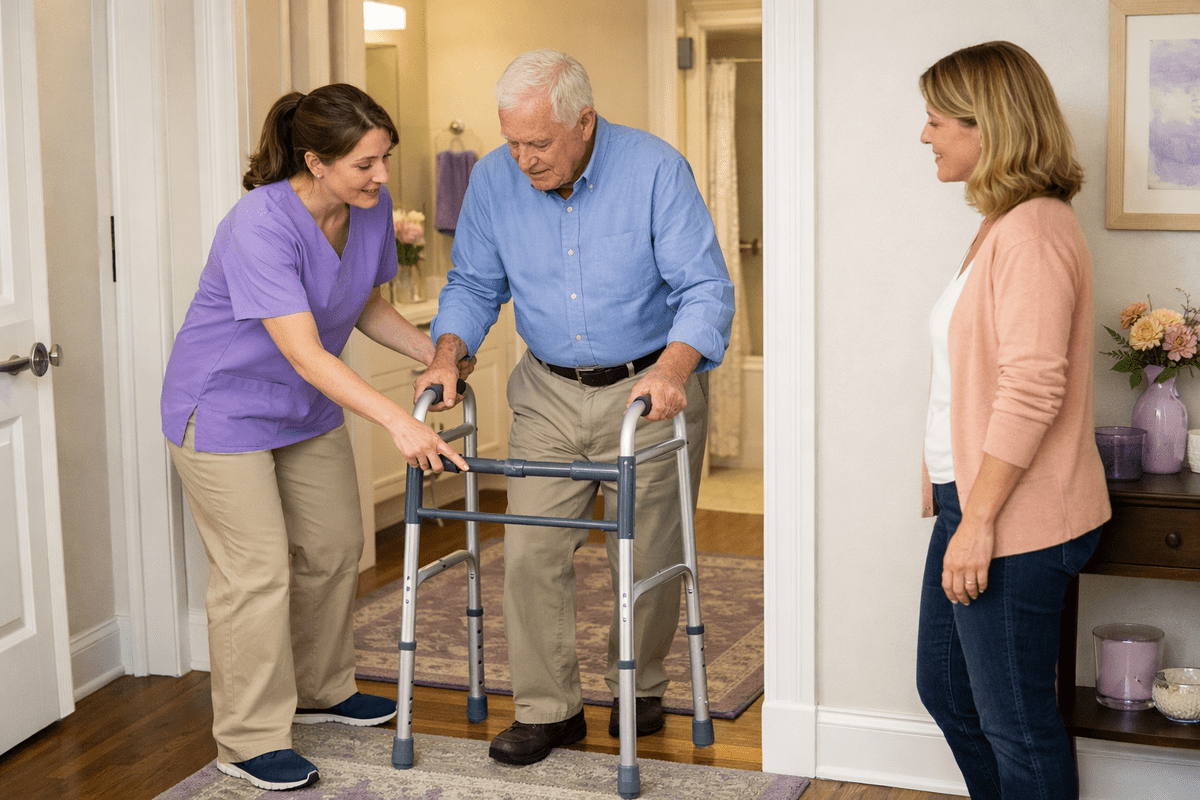
A walker can help a person stay mobile, but only if it is used correctly in the places where daily life happens. Many patients do well in a clinic hallway and then struggle at home with rugs, thresholds, tight bathrooms, furniture, pets, narrow doorways, turns, and fatigue. Families may assume the walker itself solves the safety problem, but unsafe walker habits can increase fall risk.
Walker training at home gives patients occupational therapy support for using a walker during real daily routines. The therapist can assess how the patient approaches chairs, toilets, showers, bedrooms, kitchens, hallways, and doorways. The goal is to help the patient use the walker in a way that supports independence without creating new hazards.
HarvardCare Home Health helps patients and families make walker use more practical. Training can be especially helpful after hospitalization, surgery, a fall, weakness, balance decline, arthritis, neurological change, or a new walker prescription. The therapist can focus on safety during the movements that matter most at home.
Why Walker Use at Home Is Different From Clinic Practice
Clinics often have wide hallways, smooth floors, bright lighting, and fewer obstacles. Homes are different. A patient may need to turn around a coffee table, step over a small threshold, enter a bathroom with limited space, back up to a chair, carry an item, avoid rugs, or move through a hallway where the walker barely fits. These details change how safe walker use needs to be taught.
Patients may also develop unsafe habits. They may push the walker too far ahead, lean too heavily, pick it up at the wrong time, turn too quickly, abandon it before sitting, or use it to pull up from a chair. Some patients forget the walker when they feel confident and then lose balance when tired or distracted. Others become so dependent on the walker that they stop using available strength and posture.
Occupational therapy helps connect walker use to daily tasks such as toileting, dressing, bathing preparation, kitchen mobility, and transfers. The therapist can teach the patient how to move safely while still completing the routine.
Fitting, Turns, Thresholds, Rugs, and Narrow Spaces
The therapist may check whether the walker height appears appropriate and whether the patient can keep an upright posture. While medical equipment providers may handle formal fitting or replacement, the therapist can observe whether the walker is being used in a way that creates shoulder strain, poor posture, or unsafe reaching.
Training may include turning slowly, keeping the walker close, approaching thresholds, managing doorway transitions, avoiding unsafe rugs, and positioning the walker before sitting or standing. If the bathroom is narrow, the therapist may help the patient practice a safer approach or recommend setup changes. If the walker does not fit through a space, the plan may need equipment review, furniture changes, or different assistance.
Common home challenges include:
- Area rugs or rug edges that catch walker legs.
- Bathroom doors that open into the walker path.
- Low chairs that encourage pulling on the walker.
- Thresholds between rooms or at exterior doors.
- Poor lighting during nighttime bathroom trips.
- Cluttered pathways near the bed, chair, or kitchen.
What OT May Practice During Visits
The occupational therapist may practice walker use during daily activities, not only walking in a straight line. The patient may practice approaching the toilet, turning to sit, moving toward a shower chair, standing at a sink, retrieving clothing, entering the kitchen, or moving from bed to chair. This helps the patient learn how walker placement changes depending on the task.
For example, the therapist may teach the patient not to park the walker too far away before reaching for the sink, not to step outside the walker during turns, and not to leave the walker behind when backing toward a chair. The therapist may also teach caregivers how to cue walker use without yelling too many instructions at once.
If the patient has pain, weakness, dizziness, or shortness of breath, the therapist may add pacing strategies. This can include planned rest breaks, sitting before fatigue becomes severe, and arranging the home so frequently used items are reachable without unsafe carrying or bending.
Safety Checklist for Families
Families can support walker safety by looking at the home from the patient’s perspective. A path that seems clear to a visitor may be difficult for a person using a walker. The therapist may help families create a safer setup that still feels like home.
A basic family checklist may include:
- Keep the walker within reach before the patient stands.
- Clear pathways from bed to bathroom and chair to kitchen.
- Remove loose rugs or secure edges when appropriate.
- Improve lighting, especially at night.
- Avoid carrying heavy or hot items while using the walker.
- Use chairs with stable arms when possible.
When Physical Therapy May Also Help
Occupational therapy often focuses on walker use during daily routines, transfers, and home safety. Physical therapy may also be appropriate when the patient needs gait training, balance work, strengthening, endurance building, or stair practice. Many patients benefit from both services when walking safety affects daily independence.
HarvardCare Home Health can help families understand whether In-Home Physical Therapy Services should be considered along with In-Home Occupational Therapy, Transfer Training at Home, or Fall Risk Assessment at Home.
Why Choose HarvardCare Home Health
Walker training is most useful when it happens inside the real home. HarvardCare Home Health therapists can see the narrow doorway, the bathroom turn, the favorite chair, the rug edge, and the nighttime path. That makes recommendations more specific than general walker advice.
Our approach is practical and patient-friendly. The therapist can help the patient use the walker during meaningful routines such as toileting, bathing setup, dressing, transfers, and simple household movement. The focus is safer independence, not fear-based restriction.
Medicare and Home Health Eligibility
Walker training may be part of home health occupational therapy when eligibility requirements are met. Coverage may depend on physician order, skilled need, homebound status, and payer review. Coverage cannot be guaranteed without an eligibility review.
If walker use has become unsafe after a fall, hospital stay, surgery, illness, or decline in balance or strength, HarvardCare Home Health can review the request and help determine whether skilled home therapy is appropriate.
Related Services
Walker training may connect with ADL Training at Home, Toilet Transfer Training at Home, Bed to Chair Transfer Training at Home, Home Safety Evaluation, and Adaptive Equipment Training at Home.
Request Walker Training at Home
If walker use feels unsafe in the bathroom, hallway, bedroom, or daily routines, complete the form on this page or call HarvardCare Home Health. The team can review the request, discuss eligibility, and help determine whether home occupational therapy should be started.
FAQs
Do you have questions?
Got questions about Walker Training at Home? Here are answers to what patients and families ask most.
Yes. The therapist can assess bathroom entry, turning space, toilet approach, shower setup, and walker placement during ADLs.
The therapist may observe walker height and use, but equipment replacement or formal fitting may require coordination with the provider or equipment supplier.
It may reduce risk by improving walker placement, turning, transfers, home setup, and family cueing. It cannot eliminate all fall risk.
Rugs, thresholds, clutter, lighting, narrow doorways, low chairs, bathroom layout, and nighttime paths may be reviewed.
Yes. Caregivers can learn simple cues, supervision strategies, and ways to keep the walker available without taking over.
Physical therapy may help when gait, balance, leg strength, endurance, or stairs are major concerns.
Yes. Sit-to-stand and stand-to-sit with walker positioning are common parts of home walker training.
It may be covered when home health requirements are met, including physician order, skilled need, and homebound status when applicable. Eligibility must be reviewed.
Complete the form on this page or call HarvardCare Home Health so the team can review the request and next steps.
TESTIMONIALS
What Our Patients & Families Say
EXCELLENT 
AREAS WE SERVE
Walker Training at Home Near You
Our licensed healthcare professionals provide expert care in the comfort of your home. We proudly serve patients and families throughout Los Angeles County.
Serving 97 cities across LA County
- A
- Agoura Hills
- Alhambra
- Altadena
- Arcadia
- B
- Bel Air
- Bellflower
- Beverly Hills
- Boyle Heights
- Brentwood
- Burbank
- C
- Calabasas
- Carson
- Century City
- Cerritos
- Claremont
- Compton
- Covina
- Culver City
- D
- Diamond Bar
- Downey
- E
- Eagle Rock
- East Los Angeles
- Echo Park
- Encino
- G
- Gardena
- Glendale
- Glendora
- Granada Hills
- H
- Hacienda Heights
- Hancock Park
- Harbor City
- Hawthorne
- Highland Park
- Hollywood
- Hollywood Hills
- I
- Inglewood
- K
- Koreatown
- L
- La Crescenta-Montrose
- La Mirada
- Lakewood
- Lincoln Heights
- Long Beach
- Los Angeles
- Los Feliz
- M
- Malibu
- Manhattan Beach
- Mar Vista
- Marina del Rey
- Mid-City
- Mid-Wilshire
- Miracle Mile
- Monrovia
- Montebello
- Monterey Park
- N
- North Hollywood
- Northridge
- Norwalk
- P
- Pacific Palisades
- Palms
- Palos Verdes Estates
- Palos Verdes Peninsula
- Panorama City
- Pasadena
- Pico Rivera
- Playa Vista
- Pomona
- Porter Ranch
- R
- Rancho Palos Verdes
- Redondo Beach
- Reseda
- Rolling Hills Estates
- Rowland Heights
- S
- San Dimas
- San Gabriel
- San Marino
- San Pedro
- Santa Clarita
- Santa Monica
- Sawtelle
- Sherman Oaks
- Silver Lake
- South Gate
- South Pasadena
- Studio City
- T
- Tarzana
- Torrance
- V
- Van Nuys
- Venice
- W
- West Covina
- West Hollywood
- West Los Angeles
- Westchester
- Westlake Village
- Westwood
- Whittier
- Wilmington
- Woodland Hills
More Services

In-Home Wound Care Services
- Board-certified wound care nurses
- Personalized treatment plans
- All wound types treated
Diabetic Wound Care at Home
- Diabetes wound specialists
- Blood sugar optimization support
- Advanced offloading techniques
Skilled Nursing Care at Home
- Registered nurses available 7 days a week
- Comprehensive care coordination
- IV therapy and infusion services