
 Wound Care
It is skilled wound nursing care for pressure-related skin breakdown, including assessment, ordered dressing care, pressure relief education, and physician updates.
WOUND CARE
Bedsore Treatment at Home
Bedsore treatment at home helps patients with pressure injuries receive skilled wound care, dressing support, repositioning education, and physician updates.
EXCELLENT 


Bedsore Treatment at Home for Pressure-Related Wounds
Bedsore Treatment at Home supports patients who have pressure-related skin breakdown and need skilled nursing care in the home. Bedsores, also called pressure injuries or pressure ulcers, can develop when pressure limits blood flow to skin and tissue. They often occur over the tailbone, hips, heels, ankles, elbows, or other bony areas. For patients with limited mobility, weakness, incontinence, poor nutrition, or reduced sensation, a bedsore can worsen quickly without consistent care.
HarvardCare Home Health provides skilled wound nursing support for bedsore treatment throughout Los Angeles County. Our nurses follow physician orders, assess the wound and surrounding skin, provide ordered dressing care, teach pressure relief routines, and communicate changes to the physician. The service helps patients receive care where they are most comfortable while giving families clearer guidance on how to protect vulnerable skin between visits.
Who May Need Bedsore Treatment at Home?
This service may help patients who spend long periods in bed or in a chair, have difficulty changing positions, recently returned home from the hospital, or already have a pressure injury. It may also help patients with stroke, advanced illness, spinal cord injury, dementia, severe weakness, or any condition that makes movement difficult. Bedsores are not simply a skin problem. They often reflect pressure, moisture, nutrition, circulation, and mobility challenges that need a coordinated plan.
Families may notice redness that does not fade, an open sore, drainage, pain, skin warmth, odor, or darkened tissue. On darker skin tones, a pressure injury may look purple, blue, gray, shiny, or warmer than surrounding skin instead of bright red. A skilled nurse can help evaluate changes and communicate with the physician when treatment needs to be adjusted.
What This Service Includes
Bedsore treatment at home begins with assessment. The nurse checks the wound location, appearance, drainage, surrounding skin, pain, odor, and whether pressure is continuing on the area. The nurse follows the ordered dressing plan and documents progress. Care may include wound cleansing and dressing changes as ordered, infection warning monitoring, skin protection education, and guidance on keeping the wound clean and covered.
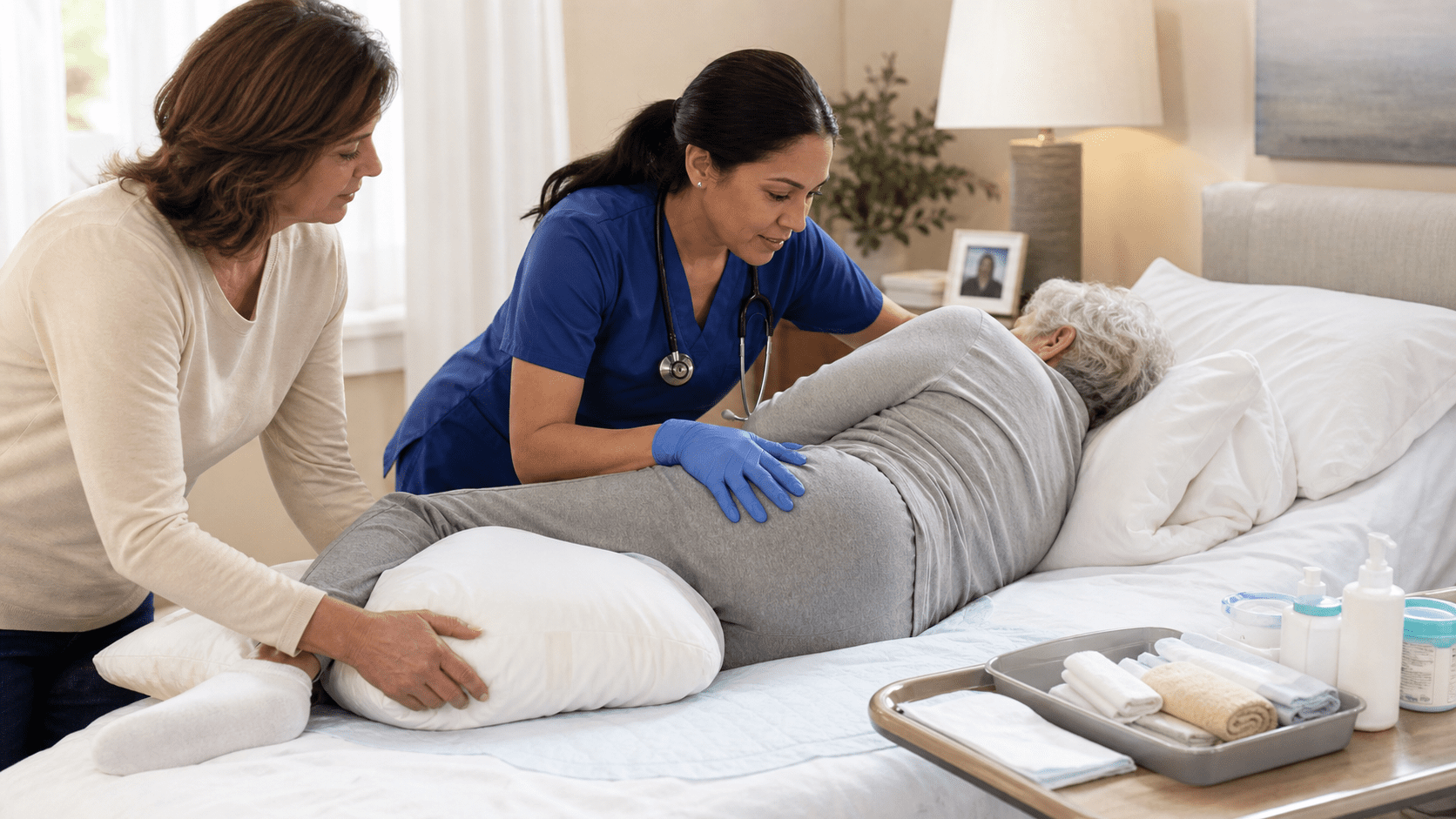
Pressure relief is a central part of care. The nurse may teach caregivers how to reposition safely, use pillows to reduce pressure, protect heels, keep sheets smooth, and avoid dragging the skin during transfers. The nurse may also discuss moisture control, nutrition questions to raise with the physician, and when support surfaces or equipment should be discussed. The goal is to treat the current wound and reduce the chance of new pressure injuries.
When Bedsore Treatment May Be Needed
A patient may need skilled bedsore treatment when the skin has opened, drainage is present, pain is increasing, the wound is not improving, or caregivers are unsure how to manage dressings or repositioning. Skilled care may also be needed when the wound is near the tailbone or another difficult-to-see location, when the patient cannot report pain clearly, or when infection risk is high.
Bedsores can become serious if ignored. Warning signs include spreading redness or warmth, swelling, odor, pus-like drainage, fever, increasing pain, dark or black tissue, or a wound that becomes deeper. These symptoms should be reported promptly. The nurse can help families understand what is expected and what should trigger a call to the physician.
What Families Can Expect During Visits
The nurse will protect the patient privacy, assess the wound, provide ordered care, and teach the family how to reduce pressure between visits. For many families, the biggest benefit is understanding how positioning, bedding, moisture, nutrition, and daily skin checks work together. A bedsore plan usually requires repeated small actions, not just a dressing change during the nursing visit.
Caregivers can ask questions during visits and practice safer positioning techniques with nurse guidance. The plan should fit the home setting, the patient comfort, and the caregiver ability. Small adjustments, repeated consistently, can help protect vulnerable skin. If the current setup is not working, the nurse can communicate concerns and help the physician decide whether the care plan needs review.
How HarvardCare Home Health Helps
HarvardCare Home Health brings skilled wound care and caregiver teaching into the home. Our nurses provide structured visits that focus on the wound, the pressure source, and the daily routine. They check whether the dressing is staying in place, whether the patient is being repositioned safely, whether moisture is irritating the skin, and whether new areas are at risk. When concerns appear, the nurse can update the physician and help the family understand next steps.
Bedsore treatment may connect with related services such as pressure ulcer care at home, wound dressing changes at home, non-healing wound care at home, and broader in-home wound care services. If infection is suspected, patients may also need evaluation for infected wound care at home.
Medicare and Home Health Eligibility
Bedsore treatment may be covered through home health when eligibility requirements are met, the patient has a physician order, is homebound under Medicare rules, and needs intermittent skilled nursing wound care. Coverage depends on the patient condition, payer requirements, and ordered services. HarvardCare Home Health can help families understand what information may be needed for referral and eligibility review.
Families should seek urgent medical guidance if the patient has fever, confusion, rapidly spreading redness, severe pain, foul odor, black tissue, or sudden worsening. Home health nursing can support safe treatment at home, but serious infection signs need prompt medical attention. The safest plan is one where families know what can wait for the next visit and what should be escalated immediately.
Frequently Asked Questions and Next Steps
The FAQ section for this service addresses pressure relief, warning signs, physician orders, caregiver education, visit frequency, and Medicare home health eligibility. These answers are general and should be paired with the patient specific plan from the physician and nurse. A bedsore care plan may change as the wound responds, the patient mobility changes, or the physician updates orders.
Patients with bedsores often need more than one form of support. Depending on the physician plan, related care may include a home health nurse visit, skilled nursing care at home, or Wound VAC therapy at home when ordered. To ask about care, use Contact or Secure Intake.
FAQs
Do you have questions?
Got questions about Bedsore Treatment at Home? Here are answers to what patients and families ask most.
It may help patients with wounds, risk factors, limited mobility, recent hospital discharge, diabetes, circulation concerns, or caregivers who need skilled guidance at home.
Home health services generally require physician orders. HarvardCare Home Health can help explain what referral information may be needed.
It may be covered when Medicare home health requirements are met, the patient is homebound, and a physician orders skilled nursing wound care.
Visit frequency depends on the wound, physician orders, drainage, risk level, and how much skilled care is needed. The plan may change as healing progresses.
Report fever, spreading redness, warmth, swelling, odor, pus-like drainage, worsening pain, black tissue, or a wound that suddenly looks worse.
Yes. Nurses teach practical steps such as protecting the dressing, watching for changes, keeping supplies clean, and knowing when to call for help.
No. Severe symptoms, rapid worsening, confusion, fever, or suspected serious infection should be handled with urgent medical guidance or emergency care.
Have medication lists, discharge paperwork, wound care orders, dressing supplies, insurance information, and physician contact details available if possible.
Contact HarvardCare Home Health or submit secure intake information so the team can review the situation and explain next steps for referral and eligibility review.
TESTIMONIALS
What Our Patients & Families Say
AREAS WE SERVE
Bedsore Treatment at Home Near You
Our licensed healthcare professionals provide expert care in the comfort of your home. We proudly serve patients and families throughout Los Angeles County.
Serving 279 cities across LA County
- A
- Acton
- Adams-Normandie
- Agoura Hills
- Agua Dulce
- Alhambra
- Alondra Park
- Altadena
- Angelino Heights
- Arcadia
- Arleta
- Arlington Heights
- Artesia
- Arts District
- Atwater Village
- Avocado Heights
- Azusa
- B
- Baldwin Hills
- Baldwin Park
- Bassett
- Beachwood Canyon
- Bel Air
- Bell
- Bell Gardens
- Bellflower
- Beverly Crest
- Beverly Grove
- Beverly Hills
- Beverlywood
- Boyle Heights
- Bradbury
- Brentwood
- Broadway-Manchester
- Burbank
- C
- Calabasas
- Canoga Park
- Canyon Country
- Carson
- Carthay
- Castaic
- Castle Heights
- Central-Alameda
- Century City
- Cerritos
- Charter Oak
- Chatsworth
- Chesterfield Square
- Cheviot Hills
- Chinatown
- Citrus
- City Terrace
- Claremont
- Commerce
- Compton
- Country Club Park
- Covina
- Crenshaw
- Cudahy
- Culver City
- Cypress Park
- D
- Del Aire
- Del Rey
- Desert View Highlands
- Diamond Bar
- Downey
- Downtown Los Angeles
- Duarte
- E
- Eagle Rock
- East Hollywood
- East Los Angeles
- East Pasadena
- East Rancho Dominguez
- East San Gabriel
- East Whittier
- Echo Park
- El Camino Village
- El Monte
- El Segundo
- El Sereno
- Elysian Valley
- Encino
- Exposition Park
- F
- Fairfax
- Florence
- Florence-Firestone
- G
- Gardena
- Garvanza
- Glassell Park
- Glendale
- Glendora
- Gramercy Park
- Granada Hills
- Green Meadows
- H
- Hacienda Heights
- Hancock Park
- Harbor City
- Harbor Gateway
- Harvard Heights
- Harvard Park
- Hasley Canyon
- Hawaiian Gardens
- Hawthorne
- Hermon
- Hermosa Beach
- Hidden Hills
- Highland Park
- Historic Filipinotown
- Hollywood
- Hollywood Hills
- Holmby Hills
- Huntington Park
- Hyde Park
- I
- Inglewood
- J
- Jefferson Park
- K
- Kinneloa Mesa
- Koreatown
- L
- La Cañada Flintridge
- La Crescenta-Montrose
- La Habra Heights
- La Mirada
- La Puente
- La Verne
- Ladera Heights
- Lake Balboa
- Lake Hughes
- Lake Los Angeles
- Lake View Terrace
- Lakewood
- Lancaster
- Larchmont
- Lawndale
- Leimert Park
- Lennox
- Leona Valley
- Lincoln Heights
- Little Armenia
- Little Tokyo
- Littlerock
- Lomita
- Long Beach
- Los Angeles
- Los Feliz
- Lynwood
- M
- Malibu
- Manchester Square
- Manhattan Beach
- Mar Vista
- Marina del Rey
- Mayflower Village
- Maywood
- Mid-City
- Mid-Wilshire
- Miracle Mile
- Mission Hills
- Monrovia
- Montebello
- Montecito Heights
- Monterey Park
- Mt Washington
- N
- Newhall
- NoHo Arts District
- North El Monte
- North Hills
- North Hollywood
- North Long Beach
- Northridge
- Norwalk
- P
- Pacific Palisades
- Pacoima
- Palmdale
- Palms
- Palos Verdes Estates
- Palos Verdes Peninsula
- Panorama City
- Paramount
- Park La Brea
- Pasadena
- Pearblossom
- Pico Rivera
- Pico-Robertson
- Pico-Union
- Playa del Rey
- Playa Vista
- Pomona
- Porter Ranch
- Q
- Quartz Hill
- R
- Rancho Dominguez
- Rancho Palos Verdes
- Rancho Park
- Redondo Beach
- Reseda
- Rolling Hills
- Rolling Hills Estates
- Rosemead
- Rowland Heights
- S
- San Dimas
- San Fernando
- San Gabriel
- San Marino
- San Pasqual
- San Pedro
- Santa Clarita
- Santa Fe Springs
- Santa Monica
- Saugus
- Sawtelle
- Sepulveda
- Shadow Hills
- Sherman Oaks
- Sherman Village
- Sherwood Forest
- Sierra Madre
- Signal Hill
- Silver Lake
- South Central
- South El Monte
- South Gate
- South Park
- South Pasadena
- South San Gabriel
- South San Jose Hills
- South Whittier
- Stevenson Ranch
- Stonehurst
- Studio City
- Sun Valley
- Sun Village
- Sunland
- Sunset Park
- Sylmar
- T
- Tarzana
- Temple City
- Thai Town
- Toluca Lake
- Topanga
- Torrance
- Tujunga
- U
- University Hills
- University Park
- V
- Val Verde
- Valencia
- Valinda
- Valley Glen
- Valley Village
- Van Nuys
- Venice
- Vermont Knolls
- Vermont Square
- Vermont Vista
- Vermont-Slauson
- Victor Heights
- View Park-Windsor Hills
- Vincent
- W
- Walnut
- Walnut Park
- Watts
- West Adams
- West Athens
- West Carson
- West Covina
- West Hills
- West Hollywood
- West Los Angeles
- West Puente Valley
- West Rancho Dominguez
- West Whittier-Los Nietos
- Westchester
- Westlake
- Westlake Village
- Westmont
- Westwood
- Westwood Village
- Whitley Heights
- Whittier
- Willowbrook
- Wilmington
- Wilshire Center
- Windsor Square
- Winnetka
- Woodland Hills
More Services

In-Home Wound Care Services
- Board-certified wound care nurses
- Personalized treatment plans
- All wound types treated
Diabetic Wound Care at Home
- Diabetes wound specialists
- Blood sugar optimization support
- Advanced offloading techniques
Skilled Nursing Care at Home
- Registered nurses available 7 days a week
- Comprehensive care coordination
- IV therapy and infusion services