
 Wound Care
It is speech-language therapy for language problems such as speaking, understanding, reading, and writing after stroke, brain injury, or neurological illness.
SPEECH THERAPY
Aphasia Therapy at Home
In-home aphasia therapy for speaking, understanding, reading, writing, caregiver communication, and daily participation.
EXCELLENT 


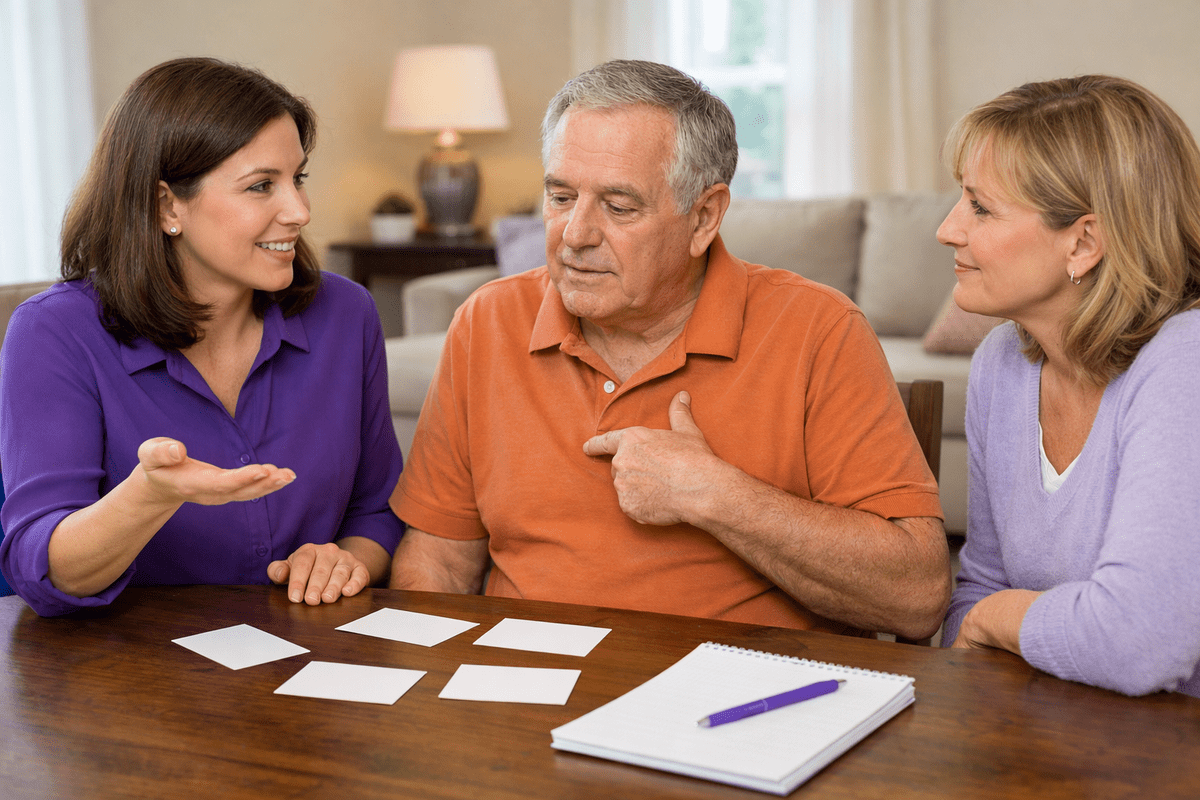
Aphasia can change communication suddenly and deeply. A patient may understand more than they can say, speak fluently but use the wrong words, struggle to read, or have trouble following conversation. Families may feel heartbroken because the person they love is still present, but communication has become harder.
Aphasia therapy at home gives patients and caregivers skilled support in a familiar environment. The speech-language pathologist can work on speaking, understanding, reading, writing, gestures, choices, and communication tools while also teaching family members how to support conversation without taking away independence.
HarvardCare Home Health helps families approach aphasia with patience, structure, and practical goals. Therapy may not restore communication overnight, but it can help the patient participate more fully, reduce frustration, and give the family better ways to connect during daily routines.
What aphasia can look like
Aphasia is a language disorder that often happens after stroke or brain injury. It affects the ability to understand or use language. Aphasia is not the same as memory loss, hearing loss, or lack of intelligence, although those issues can also be present.
- Difficulty finding the right word.
- Using words that do not match the intended meaning.
- Trouble understanding questions or longer sentences.
- Speaking in short phrases or incomplete sentences.
- Difficulty reading mail, labels, or messages.
- Trouble writing names, numbers, or short notes.
- Frustration, withdrawal, or emotional reactions during communication.
Every person with aphasia is different. Some understand well but cannot speak easily. Others speak easily but are hard to understand. A careful SLP assessment helps identify the pattern and choose the most useful home strategies.
How aphasia affects daily life
Aphasia can affect safety, relationships, and independence. A patient may struggle to report pain, answer medical questions, request the bathroom, choose food, talk on the phone, or explain a concern. Family members may accidentally ask questions that are too complex or rush the patient before they can respond.
Home therapy can focus on real-life communication. The SLP may help the patient practice names of family members, common needs, emergency information, meal choices, appointment routines, and simple conversation repair. This helps therapy feel connected to what the patient and family actually need.
Speaking and word finding
Therapy may include naming practice, sentence building, repetition, describing objects, using gestures, and practicing common phrases. The SLP may teach the family how to cue without giving the answer too quickly.
Understanding language
If comprehension is affected, the SLP may teach caregivers to simplify instructions, use visual cues, confirm understanding, and avoid rapid topic changes. This can reduce confusion and improve safety.
Reading and writing
Some patients benefit from functional reading or writing practice, such as names, dates, simple choices, appointment reminders, or key words that support conversation.
What therapy may include
Aphasia therapy at home may combine structured language practice with functional communication tasks. The SLP may use blank cue cards, objects, photos supplied by the family, gestures, writing, drawing, yes-or-no systems, or communication boards. Any tool should fit the patient abilities and home routine.
| Therapy focus | Possible home activity |
|---|---|
| Word retrieval | Practice naming household items and describing their use. |
| Conversation | Practice greetings, choices, family names, and common requests. |
| Comprehension | Follow short directions related to daily routines. |
| Supported communication | Use gestures, writing, pointing, or choices to repair breakdowns. |
Therapy may also include education about fatigue. Communication can become harder when the patient is tired, distracted, in pain, or overwhelmed. Families may learn to choose the best time of day for practice.
Family communication strategies
Family support is central to aphasia therapy. The patient should be treated as an adult partner in conversation, even when words are difficult. Caregivers may need to slow down, make eye contact, reduce noise, offer written or visual supports, and confirm the message respectfully.
- Speak naturally but use shorter sentences.
- Ask one question at a time.
- Offer choices instead of open-ended questions when needed.
- Allow extra response time.
- Encourage gestures, pointing, drawing, or writing.
- Confirm what you think the patient means before moving on.
These strategies can reduce frustration because the family is no longer guessing how to help. They also support dignity by keeping the patient involved in decisions.
Helping the patient stay involved
Aphasia can make families accidentally leave the patient out of conversation. People may talk around the patient because it seems faster, or they may answer every question for them. The SLP can help the family slow the interaction down so the patient has a chance to participate.
Participation may include pointing to a choice, confirming yes or no, using a gesture, writing a first letter, repeating a practiced phrase, or selecting from a simple set of options. These methods are not lesser forms of communication. They are practical tools that can help the patient stay connected while language skills are recovering or adapting.
The home setting is valuable because the SLP can see where communication breaks down. Maybe family members ask questions from another room. Maybe the television is on during important conversations. Maybe the patient needs a quiet place and a consistent cueing system. Small home changes can make communication more successful.
Aphasia therapy may also include planning for common high-stress moments. A patient may need a simple way to answer medical questions, participate in a provider call, choose meals, or tell a caregiver something feels wrong. Practicing those situations at home can help the family respond with less panic when words are difficult.
Those planned phrases and supports can be kept near the phone, dining table, or favorite chair so they are available when communication pressure is highest.
The SLP can revise supports as the patient improves, becomes fatigued, or needs a simpler communication path.
Why choose HarvardCare Home Health
HarvardCare Home Health understands that aphasia affects the whole family. Our speech-language therapy approach is practical, respectful, and focused on communication that matters at home. We help families build a shared way to support the patient during real conversations.
Patients with aphasia may also have stroke-related mobility, swallowing, cognition, or daily activity needs. Related services may include stroke rehab at home, swallowing therapy at home, cognitive rehab at home, in-home occupational therapy, and skilled nursing care at home.
Medicare and home health eligibility note
Aphasia therapy may be available through home health when there is a provider order, a skilled need, and the patient meets requirements such as homebound status. Coverage is not guaranteed. HarvardCare Home Health must review eligibility, documentation, payer rules, and clinical need before services can begin.
Request aphasia therapy at home
If aphasia is affecting communication after stroke, brain injury, or another medical condition, complete the form on this page or call HarvardCare Home Health. The team can review the request and help determine whether home health speech therapy is appropriate.
FAQs
Do you have questions?
Got questions about Aphasia Therapy at Home? Here are answers to what patients and families ask most.
No. Aphasia is a language disorder. A person may think clearly but have difficulty understanding or expressing language.
Some patients improve with time and therapy, but progress varies. Therapy can also teach strategies that improve daily communication.
The SLP may assess language, practice speaking and understanding, teach communication tools, and train caregivers.
Yes. Caregivers can learn how to cue, wait, confirm messages, offer choices, and reduce communication frustration.
When appropriate, therapy may include functional reading and writing practice for home routines.
Yes. Aphasia commonly occurs after stroke, especially when language areas of the brain are affected.
Coverage is not guaranteed. Home health generally requires a provider order, skilled need, homebound status, and eligibility review.
Yes. Speech therapy may coordinate with occupational therapy, physical therapy, nursing, and the provider when appropriate.
Complete the form on this page or call HarvardCare Home Health so the request and eligibility can be reviewed.
TESTIMONIALS
What Our Patients & Families Say
AREAS WE SERVE
Aphasia Therapy at Home Near You
Our licensed healthcare professionals provide expert care in the comfort of your home. We proudly serve patients and families throughout Los Angeles County.
Serving 279 cities across LA County
- A
- Acton
- Adams-Normandie
- Agoura Hills
- Agua Dulce
- Alhambra
- Alondra Park
- Altadena
- Angelino Heights
- Arcadia
- Arleta
- Arlington Heights
- Artesia
- Arts District
- Atwater Village
- Avocado Heights
- Azusa
- B
- Baldwin Hills
- Baldwin Park
- Bassett
- Beachwood Canyon
- Bel Air
- Bell
- Bell Gardens
- Bellflower
- Beverly Crest
- Beverly Grove
- Beverly Hills
- Beverlywood
- Boyle Heights
- Bradbury
- Brentwood
- Broadway-Manchester
- Burbank
- C
- Calabasas
- Canoga Park
- Canyon Country
- Carson
- Carthay
- Castaic
- Castle Heights
- Central-Alameda
- Century City
- Cerritos
- Charter Oak
- Chatsworth
- Chesterfield Square
- Cheviot Hills
- Chinatown
- Citrus
- City Terrace
- Claremont
- Commerce
- Compton
- Country Club Park
- Covina
- Crenshaw
- Cudahy
- Culver City
- Cypress Park
- D
- Del Aire
- Del Rey
- Desert View Highlands
- Diamond Bar
- Downey
- Downtown Los Angeles
- Duarte
- E
- Eagle Rock
- East Hollywood
- East Los Angeles
- East Pasadena
- East Rancho Dominguez
- East San Gabriel
- East Whittier
- Echo Park
- El Camino Village
- El Monte
- El Segundo
- El Sereno
- Elysian Valley
- Encino
- Exposition Park
- F
- Fairfax
- Florence
- Florence-Firestone
- G
- Gardena
- Garvanza
- Glassell Park
- Glendale
- Glendora
- Gramercy Park
- Granada Hills
- Green Meadows
- H
- Hacienda Heights
- Hancock Park
- Harbor City
- Harbor Gateway
- Harvard Heights
- Harvard Park
- Hasley Canyon
- Hawaiian Gardens
- Hawthorne
- Hermon
- Hermosa Beach
- Hidden Hills
- Highland Park
- Historic Filipinotown
- Hollywood
- Hollywood Hills
- Holmby Hills
- Huntington Park
- Hyde Park
- I
- Inglewood
- J
- Jefferson Park
- K
- Kinneloa Mesa
- Koreatown
- L
- La Cañada Flintridge
- La Crescenta-Montrose
- La Habra Heights
- La Mirada
- La Puente
- La Verne
- Ladera Heights
- Lake Balboa
- Lake Hughes
- Lake Los Angeles
- Lake View Terrace
- Lakewood
- Lancaster
- Larchmont
- Lawndale
- Leimert Park
- Lennox
- Leona Valley
- Lincoln Heights
- Little Armenia
- Little Tokyo
- Littlerock
- Lomita
- Long Beach
- Los Angeles
- Los Feliz
- Lynwood
- M
- Malibu
- Manchester Square
- Manhattan Beach
- Mar Vista
- Marina del Rey
- Mayflower Village
- Maywood
- Mid-City
- Mid-Wilshire
- Miracle Mile
- Mission Hills
- Monrovia
- Montebello
- Montecito Heights
- Monterey Park
- Mt Washington
- N
- Newhall
- NoHo Arts District
- North El Monte
- North Hills
- North Hollywood
- North Long Beach
- Northridge
- Norwalk
- P
- Pacific Palisades
- Pacoima
- Palmdale
- Palms
- Palos Verdes Estates
- Palos Verdes Peninsula
- Panorama City
- Paramount
- Park La Brea
- Pasadena
- Pearblossom
- Pico Rivera
- Pico-Robertson
- Pico-Union
- Playa del Rey
- Playa Vista
- Pomona
- Porter Ranch
- Q
- Quartz Hill
- R
- Rancho Dominguez
- Rancho Palos Verdes
- Rancho Park
- Redondo Beach
- Reseda
- Rolling Hills
- Rolling Hills Estates
- Rosemead
- Rowland Heights
- S
- San Dimas
- San Fernando
- San Gabriel
- San Marino
- San Pasqual
- San Pedro
- Santa Clarita
- Santa Fe Springs
- Santa Monica
- Saugus
- Sawtelle
- Sepulveda
- Shadow Hills
- Sherman Oaks
- Sherman Village
- Sherwood Forest
- Sierra Madre
- Signal Hill
- Silver Lake
- South Central
- South El Monte
- South Gate
- South Park
- South Pasadena
- South San Gabriel
- South San Jose Hills
- South Whittier
- Stevenson Ranch
- Stonehurst
- Studio City
- Sun Valley
- Sun Village
- Sunland
- Sunset Park
- Sylmar
- T
- Tarzana
- Temple City
- Thai Town
- Toluca Lake
- Topanga
- Torrance
- Tujunga
- U
- University Hills
- University Park
- V
- Val Verde
- Valencia
- Valinda
- Valley Glen
- Valley Village
- Van Nuys
- Venice
- Vermont Knolls
- Vermont Square
- Vermont Vista
- Vermont-Slauson
- Victor Heights
- View Park-Windsor Hills
- Vincent
- W
- Walnut
- Walnut Park
- Watts
- West Adams
- West Athens
- West Carson
- West Covina
- West Hills
- West Hollywood
- West Los Angeles
- West Puente Valley
- West Rancho Dominguez
- West Whittier-Los Nietos
- Westchester
- Westlake
- Westlake Village
- Westmont
- Westwood
- Westwood Village
- Whitley Heights
- Whittier
- Willowbrook
- Wilmington
- Wilshire Center
- Windsor Square
- Winnetka
- Woodland Hills
More Services

In-Home Wound Care Services
- Board-certified wound care nurses
- Personalized treatment plans
- All wound types treated
Diabetic Wound Care at Home
- Diabetes wound specialists
- Blood sugar optimization support
- Advanced offloading techniques
Skilled Nursing Care at Home
- Registered nurses available 7 days a week
- Comprehensive care coordination
- IV therapy and infusion services