
 Wound Care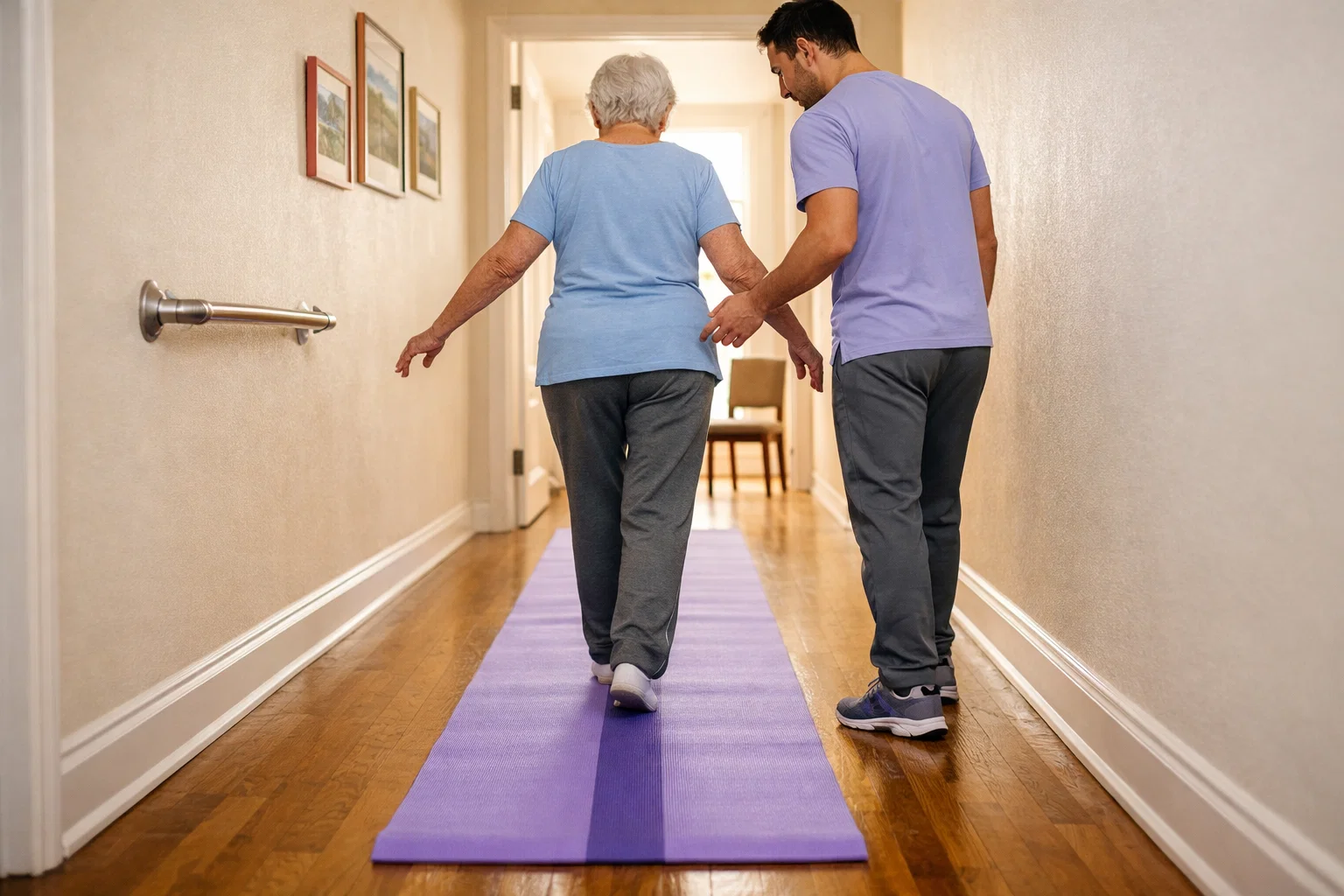

A fall changes everything. Beyond the immediate injury — a bruise, a sprain, or in more serious cases, a fracture — a fall fundamentally alters how you move through your own home. You become cautious where you were once confident. You avoid activities you used to do without thinking. You may find yourself holding onto furniture, moving slowly, or simply staying in your chair because it feels safer than risking another fall.
This fear of falling is not irrational — it’s your brain’s protective response. But left unaddressed, it creates a dangerous cycle. You move less because you’re afraid, your muscles weaken from reduced activity, your balance deteriorates further, and your risk of another fall actually increases. Breaking this cycle requires deliberate, progressive exercise that rebuilds both your physical balance and your confidence.
This guide provides safe, evidence-based exercises you can start at home, along with clear guidance on progression and when professional help from a physical therapist makes the difference.
Before You Start: Safety First
If your fall resulted in an injury — a fracture, head impact, significant swelling, or pain that hasn’t been evaluated — see your physician before starting any exercise program. These exercises are designed for individuals who have been cleared for activity and want to rebuild balance and strength.
General safety principles for home balance exercises include always having a sturdy support nearby. A kitchen counter, heavy table, or the back of a solid chair works well. Never use a surface that could slide or tip. Start every exercise with your support surface within arm’s reach. Wear supportive, non-slip footwear — avoid socks, slippers, or bare feet on smooth floors. Exercise in a clear area free of rugs, cords, or clutter. Never exercise when you’re dizzy, lightheaded, or fatigued. If you feel unsteady at any point, stop the exercise and use your support. And have someone nearby if possible, especially when you first start.
Level 1: Foundation Exercises (Week 1-2)
These exercises are appropriate for people who currently feel unsteady on their feet and need to hold onto something for most standing activities. Begin here and master each exercise before progressing.
Supported standing weight shifts. Stand behind a kitchen chair with both hands on the chair back. Slowly shift your weight to your right foot, lifting your left foot slightly off the floor (even half an inch counts). Hold for 5 seconds, then shift to the other side. Repeat 10 times per side. This teaches your body to balance on one leg — the fundamental unit of walking.
Heel raises at the counter. Stand facing your kitchen counter with both hands on the surface. Slowly rise up onto your toes, lifting your heels off the floor. Hold for 3 seconds at the top, then lower slowly. Repeat 10 times. This strengthens your calves and ankles, which are primary stabilizers for balance.
Marching in place with support. Stand behind your chair with both hands on the back. March in place by lifting one knee at a time to a comfortable height. Focus on controlled, deliberate movements rather than speed. Continue for 30 seconds, rest, and repeat 3 times. This builds hip flexor strength and practices the single-leg balance required for walking.
Sit-to-stand from a chair. Sit in a sturdy chair with your feet flat on the floor, hip-width apart. Lean forward slightly and stand up, using your hands on the armrests for assistance if needed. Stand fully upright, pause for 2 seconds, then slowly lower back down. Repeat 8 to 10 times. This is one of the most functional exercises you can do — getting out of a chair safely is essential for daily life and directly relates to fall prevention.
Tandem standing with support. Stand behind your chair with both hands on the back. Place one foot directly in front of the other, heel to toe, as if standing on a tightrope. Hold this position for 10 seconds, then switch which foot is in front. Repeat 5 times per side. This challenges your balance in a narrow base of support, which is important for navigating tight spaces at home.
Level 2: Building Confidence (Week 3-4)
Once you can perform all Level 1 exercises comfortably with two hands on support, progress by reducing your support from two hands to one hand, then from one hand to fingertip touch.
Single-leg stance with one hand. Stand next to your counter with one hand on the surface. Lift one foot off the floor and balance on the standing leg. Hold for 10 seconds. If this is easy, reduce to fingertip contact with the counter. Goal: 30 seconds per leg with minimal support. This is a direct measurement of fall risk — the ability to stand on one leg for 10+ seconds correlates with reduced fall rates.
Side stepping along the counter. Stand facing your kitchen counter with both hands on the surface. Take 10 steps to the right, then 10 steps to the left. Focus on controlled, lateral movement. As you improve, lighten your grip from full hands to fingertips. This strengthens the hip abductors — muscles on the outside of your hips that are critical for stability during walking and turning.
Heel-to-toe walking with wall support. Stand next to a wall or long counter. Walk forward by placing one foot directly in front of the other, heel touching toe. Keep the wall within arm’s reach but try not to touch it unless needed. Take 10 steps, turn, and return. This trains the balance required for navigating narrow hallways and tight spaces.
Step-ups on a low step. Stand at the bottom of a staircase or in front of a single low step (4 to 6 inches), holding the railing. Step up with your right foot, bring your left foot up to meet it, then step back down with your right foot, followed by your left. Repeat 8 times leading with the right, then 8 times leading with the left. This builds the leg strength needed for stairs and curbs.
Level 3: Advanced Balance (Week 5+)
Progress to Level 3 only when you can complete all Level 2 exercises with minimal or no support.
Single-leg stance without support. Stand in an open area (with a counter or chair within reach but not touching it). Lift one foot and balance for 30 seconds. To increase the challenge, try closing your eyes for 5 to 10 seconds — this forces your proprioceptive system to work harder. Proprioception is your body’s ability to sense its position in space without visual input, and it’s critical for preventing falls.
Backward walking. In a hallway with walls on both sides for safety, walk backward slowly for 10 steps, then walk forward to return. Focus on controlled, deliberate steps. Backward walking challenges balance and coordination in a way that forward walking does not.
Dynamic reaching. Stand on both feet without support. Reach forward, to the right, and to the left with one arm while maintaining balance. Reach to a distance that challenges your stability without causing you to step or lose balance. Repeat 10 reaches in each direction. This simulates real-life activities like reaching for items on shelves or in cabinets.
How Often Should You Exercise?
Consistency matters more than duration. Aim for balance exercises every day, or at minimum five days per week. Each session should last 15 to 20 minutes. You don’t need to complete every exercise in a single session — choose three to four exercises per session and rotate through them over the week.
Track your progress by noting which level you’re working at, how long you can hold balance positions, and how much support you need. Improvements in these metrics over weeks are concrete evidence that your balance is improving.
When to Get Professional Help
While these exercises are safe and effective for many people, certain situations benefit significantly from the expertise of a licensed physical therapist working with you in your home.
Consider in-home physical therapy if you’ve fallen more than once in the past year. If you feel unable to do these exercises safely even with support. If you have a neurological condition (stroke, Parkinson’s, MS) that affects your balance. If you’re recovering from surgery and have activity restrictions. If you’re not making progress after two to three weeks of consistent exercise. Or if your fall resulted in a fracture and you need supervised rehabilitation.
A physical therapist evaluates your specific balance deficits — strength, proprioception, vestibular function, reaction time — and creates a targeted program. They also assess your home for fall hazards and recommend modifications. This personalized approach is more effective than a general exercise program because it addresses your individual weaknesses.
Our fall prevention therapy and fall risk assessment services are available throughout Los Angeles County. A licensed physical therapist comes to your home and works with you in the actual environment where falls are most likely to occur — your bathroom, your kitchen, your hallway, your stairs.
The Fear of Falling: Addressing the Psychological Component
Physical balance exercises rebuild your body’s ability to stay upright. But the psychological impact of a fall — the anxiety, the loss of confidence, the avoidance of activity — requires attention too.
Gradual exposure is the most effective approach. By starting with supported exercises and progressively reducing your reliance on support as your strength and confidence improve, you systematically prove to yourself that you can balance safely. Each successful exercise session reinforces the neural pathways for confidence.
If fear of falling is significantly limiting your daily activities — if you’re avoiding leaving your chair, refusing to walk without someone holding your arm, or declining activities you used to enjoy — mention this to your home health team. Occupational therapy can address the functional impact of fall-related anxiety through graded activity exposure and environmental modifications.
Getting Started With Fall Prevention at Home
If you or a loved one has recently fallen, or if you’re noticing increased unsteadiness, don’t wait for another fall to seek help. Ask your physician for a home health referral that includes physical therapy for fall prevention and balance training. Learn more about how physical therapy reduces fall risk in seniors and home safety modifications to prevent falls.
Contact HarvardCare at Home at (323) 484-4440 to discuss your situation. Our physical therapists serve patients throughout Los Angeles County, including Glendale, Pasadena, Burbank, Encino, Sherman Oaks, Long Beach, and all communities across LA County.
